


Page 45 - Naval_Research_Wing_2024_12_17
P. 45
30  Sri Lanka Navy Journal                                                  Sri Lanka Navy Journal  31


 Ocean. Below figure one, denotes the strategic location of Sri Lanka in the Indian   Impact of Strategic Location on Sri Lanka’s National Identity During the
 Ocean and the world’s busiest maritime routes passing the Sri Lankan waters.  Pre-Colonial and Colonial Period

                      Attanayaka, (2021) explained that archaeological discoveries show that
               Sri Lanka’s maritime trade ties were crucial in preserving international relations
               between the East and the West in terms of religious, cultural, social, economic,
               and political channels. Indeed that has aided the country to become more ci-
               vilised and flourishing in terms of culture and business affecting the national
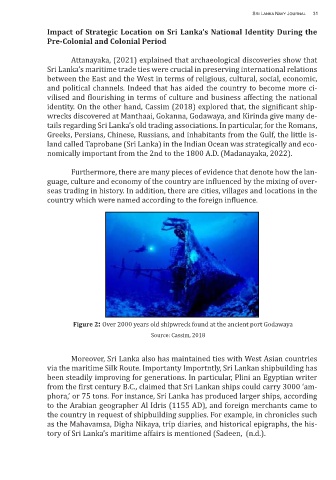
               identity. On the other hand, Cassim (2018) explored that, the significant ship-
               wrecks discovered at Manthaai, Gokanna, Godawaya, and Kirinda give many de-
               tails regarding Sri Lanka’s old trading associations. In particular, for the Romans,
               Greeks, Persians, Chinese, Russians, and inhabitants from the Gulf, the little is-
               land called Taprobane (Sri Lanka) in the Indian Ocean was strategically and eco-
               nomically important from the 2nd to the 1800 A.D. (Madanayaka, 2022).


                      Furthermore, there are many pieces of evidence that denote how the lan-
 Figure 1: Strategic Location of Sri Lanka in the Indian Ocean   guage, culture and economy of the country are influenced by the mixing of over-
               seas trading in history. In addition, there are cities, villages and locations in the
 Source: Somasunderam, 2001
               country which were named according to the foreign influence.


    Moreover, Sri Lanka is a vital strategic location and forward base for func-
 tion naval bases in order to conduct naval power projection in the IOR. Indeed, in
 history also it has proven that, Sri Lanka is an ideal location for a naval outpost
 to monitor the Indian Ocean and its increasingly congested maritime lanes.

    In particular, developing maritime traffic in the Indian Ocean connecting
 the entire globe has generated nations to increase interest on the IOR. For in-
 stance, the USA naval historian Admiral AT Mahan explained that “Whoever has
 control over the Indian Ocean has control of Asia and the fate of the globe in the
 twenty-first century will be decided on its waterways.”


    Furthermore, natural ocean current and gyres circulating in the Bay of
                       Figure 2: Over 2000 years old shipwreck found at the ancient port Godawaya
 Bengal and the Arabian Sea create two main Monsoons to the country. Indeed, it
                                              Source: Cassim, 2018
 is also a significant natural phenomenon factor that occurs due to her strategic
 location in the Indian Ocean which helps ships to navigate towards Sri Lankan
 ports using sails with the help of monsoon winds.     Moreover, Sri Lanka also has maintained ties with West Asian countries
               via the maritime Silk Route. Importanty Importntly, Sri Lankan shipbuilding has
    Importantly, the strategic geographic position of the country has given   been steadily improving for generations. In particular, Plini an Egyptian writer
 many opportunities for foreigners to land in Sri Lanka in history, today and in   from the first century B.C., claimed that Sri Lankan ships could carry 3000 ‘am-
 the future as well. However, the arrival of people from foreign nations has affect-  phora,’ or 75 tons. For instance, Sri Lanka has produced larger ships, according
 ed the national identity of the country.  to the Arabian geographer Al Idris (1155 AD), and foreign merchants came to
               the country in request of shipbuilding supplies. For example, in chronicles such
               as the Mahavamsa, Digha Nikaya, trip diaries, and historical epigraphs, the his-
               tory of Sri Lanka’s maritime affairs is mentioned (Sadeen,  (n.d.).

