


Page 65 - Naval_Research_Wing_2024_12_17
P. 65
50  Sri Lanka Navy Journal                                                  Sri Lanka Navy Journal  51


 •  Procedure Standardization.   Multinational communication
 procedures, tactical instructions, maneuvering procedures, Rules of
                                     Resources
 engagement...etc, can be standardized to ensure seamless coordina-  Maritime
                                                         cooperation
 tion among naval forces to increase interoperability.

 •  Unified C2 Structures.     Unified  command  structures  from   Transporlation
 different navies promote efficient decision-making and coordination   Naval
 by enhancing interoperability.                                        roles
                                                        Confliot and
                                     Information        competition
 •  Interoperable Technology.      Compatibility and interoperabil-
 ity of equipment, sensors, and communication systems from varied
 naval platforms with modern technologies promote integration and
                                     Dominion
 ensure seamless integration between maritime assets. Further,  the
 shared technology allows SLN to familiarize the equipment, proce-
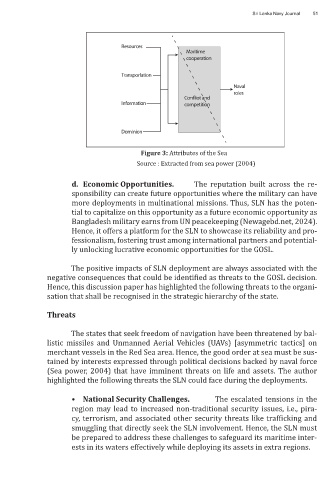
 dures, and tactics of diverse partners with each other’s capabilities   Figure 3: Attributes of the Sea
 and limitations.                         Source : Extracted from sea power (2004)

 •  Information Sharing.   Establishing  common databases,
                       d.  Economic Opportunities.          The  reputation  built  across  the  re-
 communication networks, and information-sharing  protocols en-
                       sponsibility can create future opportunities where the military can have
 sures naval forces can exchange critical information in real-time, en-
                       more deployments in multinational missions. Thus, SLN has the poten-
 hancing situational awareness and effectiveness.
                       tial to capitalize on this opportunity as a future economic opportunity as
 •  Personnel Exchange Programs.         Programs designed to ex-  Bangladesh military earns from UN peacekeeping (Newagebd.net, 2024).
 change personnel between navies during joint operations help to en-  Hence, it offers a platform for the SLN to showcase its reliability and pro-
 hance interoperability to a greater extent while allowing naval per-  fessionalism, fostering trust among international partners and potential-
 sonnel  to gain  experience in  operating  procedures and  cultures of   ly unlocking lucrative economic opportunities for the GOSL.
 partner countries.
                      The positive impacts of SLN deployment are always associated with the
 •  Doctrine Harmonization.        Seamless integration and cohe-
               negative consequences that could be identi�ied as threats to the GOSL decision.
 sive operation in a joint environment promote the aligning and har-
               Hence, this discussion paper has highlighted the following threats to the organi-
 monizing  operational  doctrines  that  facilitate information sharing,
               sation that shall be recognised in the strategic hierarchy of the state.
 joint training exercises, and technology transfer, ultimately bolster-
 ing the SLN’s capabilities. Additionally, aligning operational doctrines   Threats
 ensures consistency and clarity in mission objectives, optimizes re-
 source utilization, and promotes a unified approach to maritime chal-
                      The states that seek freedom of navigation have been threatened by bal-
 lenges,  enhancing  the  SLN’s  strategic  posture  and  influence  in  the
               listic  missiles  and  Unmanned  Aerial  Vehicles  (UAVs)  [asymmetric  tactics]  on
 maritime domain.
               merchant vessels in the Red Sea area. Hence, the good order at sea must be sus-
 c.  Broaden Security Partnerships.   The planned operation “Pros-  tained by interests expressed through political decisions backed by naval force
               (Sea power, 2004) that have imminent threats on life and assets. The author
 perity Guardian” is the largest-scale multinational maritime mission un-
               highlighted the following threats the SLN could face during the deployments.
 der the aegis of the CTF 153, a united effort of over ten key allies (Willett,
 2023).  The  evolving  situation  consequently  allows  SLN  to  strengthen
                       •  National Security Challenges.           The escalated tensions in the
 security partnerships with nations invested in maintaining regional sta-
                       region may lead to increased non-traditional security issues, i.e., pira-
 bility. This application in safeguarding the attributes [Resource, trans-
 portation, information, and dominion] of the sea would create maritime   cy, terrorism, and associated other security threats like traf�icking and
 cooperation emphasizing naval roles ( Sea power, 2004). Perhaps the col-  smuggling that directly seek the SLN involvement. Hence, the SLN must
 laborative efforts can enhance the capabilities and knowledge of the SLN   be prepared to address these challenges to safeguard its maritime inter-
 across the joint maneuvers.   ests in its waters effectively while deploying its assets in extra regions.

