


Page 21 - journal_2016_december_uploaded_2022_mar_16
P. 21
SLN  9
             MARINE POLLUTION & ENVIRONMENTAL DAMAGE IN THE GULF OF
                                              MANNAR
                                                                     Captain (H) KAPSK Kariyapperuma


               “Humans simply take too much from their natural environment. Animals and plants
        need to grow and breed. However, sometimes humans catch (or harvest) these animals and
        plants before they have had time to breed and grow. When this happens repeatedly, there are
        not enough to catch the next time. When too much is taken for too long, the end result is that
        nothing or little is left. Perhaps the best example of overexploitation is the Pearl Fisheries of the
        Gulf of Mannar.”


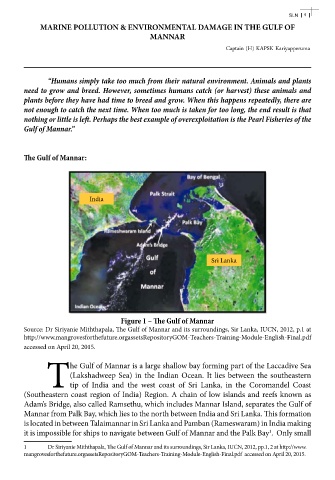
        The Gulf of Mannar:


                            India


                                                                 Sri Lanka


                                     Figure 1 – The Gulf of Mannar
        Source: Dr Siriyanie Miththapala, The Gulf of Mannar and its surroundings, Sir Lanka, IUCN, 2012, p.1 at
        http://www.mangrovesforthefuture.orgassetsRepositoryGOM-Teachers-Training-Module-English-Final.pdf
        accessed on April 20, 2015.


                      he Gulf of Mannar is a large shallow bay forming part of the Laccadive Sea
                      (Lakshadweep Sea) in the Indian Ocean. It lies between the southeastern
          Ttip  of  India  and  the  west  coast  of  Sri  Lanka,  in  the  Coromandel  Coast
        (Southeastern coast region of India) Region. A chain of low islands and reefs known as
        Adam’s Bridge, also called Ramsethu, which includes Mannar Island, separates the Gulf of
        Mannar from Palk Bay, which lies to the north between India and Sri Lanka. This formation
        is located in between Talaimannar in Sri Lanka and Pamban (Rameswaram) in India making
        it is impossible for ships to navigate between Gulf of Mannar and the Palk Bay .  Only small
                                                                                  1
        1      Dr Siriyanie Miththapala, The Gulf of Mannar and its surroundings, Sir Lanka, IUCN, 2012, pp.1, 2 at http://www.
        mangrovesforthefuture.orgassetsRepositoryGOM-Teachers-Training-Module-English-Final.pdf  accessed on April 20, 2015.

