


Page 18 - journal_2019_december_uploaded_2022_mar_16
P. 18
Sri Lanka Navy Journal  7


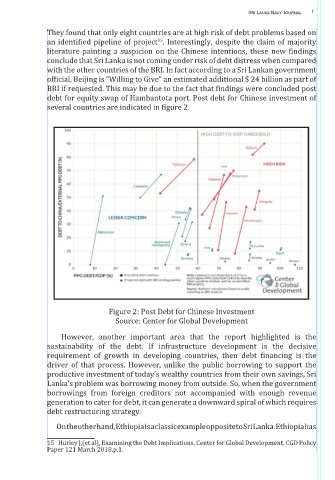
               They found that only eight countries are at high risk of debt problems based on
                                                15
               an identified pipeline of project . Interestingly, despite the claim of majority
               literature painting a suspicion on the Chinese intentions, these new findings
               conclude that Sri Lanka is not coming under risk of debt distress when compared
               with the other countries of the BRI. In fact according to a Sri Lankan government
               official, Beijing is “Willing to Give” an estimated additional $ 24 billion as part of
               BRI if requested. This may be due to the fact that findings were concluded post
               debt for equity swap of Hambantota port. Post debt for Chinese investment of
               several countries are indicated in figure 2.


                                  Figure 2: Post Debt for Chinese Investment
                                    Source: Center for Global Development

                   However,  another  important area that  the report highlighted  is  the
               sustainability  of the debt.  If infrastructure development  is the decisive
               requirement  of  growth  in  developing  countries,  then  debt  financing  is  the
               driver of that  process.  However,  unlike  the public  borrowing to  support the
               productive investment of today’s wealthy countries from their own savings, Sri
               Lanka’s problem was borrowing money from outside. So, when the government
               borrowings  from  foreign  creditors  not accompanied with enough revenue
               generation to cater for debt, it can generate a downward spiral of which requires
               debt restructuring strategy.

                  On the other hand, Ethiopia is a classic example opposite to Sri Lanka. Ethiopia has

               15   Hurley J,(et al), Examining the Debt Implications, Center for Global Development, CGD Policy
               Paper 121 March 2018.p.1.

