


Page 32 - journal_2017_december_uploaded_2023_mar_20
P. 32
Sri Lanka Navy Journal  32


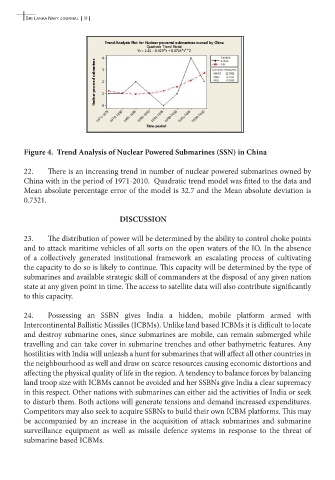
        Figure 4.  Trend Analysis of Nuclear Powered Submarines (SSN) in China

        22.    There is an increasing trend in number of nuclear powered submarines owned by
        China with in the period of 1971-2010.  Quadratic trend model was fitted to the data and
        Mean absolute percentage error of the model is 32.7 and the Mean absolute deviation is
        0.7321.


                                     DISCUSSION


        23.    The distribution of power will be determined by the ability to control choke points
        and to attack maritime vehicles of all sorts on the open waters of the IO. In the absence
        of  a  collectively  generated  institutional  framework  an  escalating  process  of  cultivating
        the capacity to do so is likely to continue. This capacity will be determined by the type of
        submarines and available strategic skill of commanders at the disposal of any given nation
        state at any given point in time. The access to satellite data will also contribute significantly
        to this capacity.


        24.    Possessing an SSBN gives India a hidden, mobile platform armed with
        Intercontinental Ballistic Missiles (ICBMs). Unlike land based ICBMs it is difficult to locate
        and destroy submarine ones, since submarines are mobile, can remain submerged while
        travelling and can take cover in submarine trenches and other bathymetric features. Any
        hostilities with India will unleash a hunt for submarines that will affect all other countries in
        the neighbourhood as well and draw on scarce resources causing economic distortions and
        affecting the physical quality of life in the region. A tendency to balance forces by balancing
        land troop size with ICBMs cannot be avoided and her SSBNs give India a clear supremacy
        in this respect. Other nations with submarines can either aid the activities of India or seek
        to disturb them. Both actions will generate tensions and demand increased expenditures.
        Competitors may also seek to acquire SSBNs to build their own ICBM platforms. This may
        be  accompanied by  an increase in  the  acquisition of  attack  submarines  and  submarine
        surveillance equipment as well as missile defence systems in response to the  threat of
        submarine based ICBMs.

