


Page 78 - journal_2020_july_uploaded_2022_mar_16
P. 78
Sri Lanka Navy Journal  65

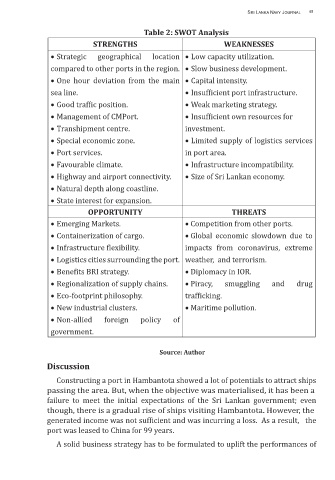
                                            Table 2: SWOT Analysis
                             STRENGTHS                              WEAKNESSES

                • Strategic   geographical     location • Low capacity utilization.
                compared to other ports in the region. • Slow business development.

                • One  hour  deviation  from  the  main  • Capital intensity.
                sea line.                                • Insufficient port infrastructure.
                • Good traffic position.                 • Weak marketing strategy.

                • Management of CMPort.                  • Insufficient own resources for
                • Transhipment centre.                   investment.
                • Special economic zone.                 • Limited supply of logistics services
                • Port services.                         in port area.
                • Favourable climate.                    • Infrastructure incompatibility.

                • Highway and airport connectivity.      • Size of Sri Lankan economy.
                • Natural depth along coastline.
                • State interest for expansion.
                           OPPORTUNITY                                 THREATS

                • Emerging Markets.                      • Competition from other ports.
                • Containerization of cargo.             • Global  economic  slowdown due to
                • Infrastructure flexibility.            impacts  from  coronavirus,  extreme
                • Logistics cities surrounding the port. weather,  and terrorism.

                • Benefits BRI strategy.                 • Diplomacy in IOR.
                • Regionalization of supply chains.      • Piracy,   smuggling     and    drug
                • Eco-footprint philosophy.              trafficking.
                • New industrial clusters.               • Maritime pollution.

                • Non-allied    foreign    policy    of
                government.

                                                  Source: Author

               Discussion

                  Constructing a port in Hambantota showed a lot of potentials to attract ships
               passing the area. But, when the objective was materialised, it has been a
               failure  to  meet  the  initial  expectations  of  the  Sri  Lankan  government;  even
               though, there is a gradual rise of ships visiting Hambantota. However, the
               generated income was not sufficient and was incurring a loss.  As a result,   the
               port was leased to China for 99 years.

                  A solid business strategy has to be formulated to uplift the performances of

